
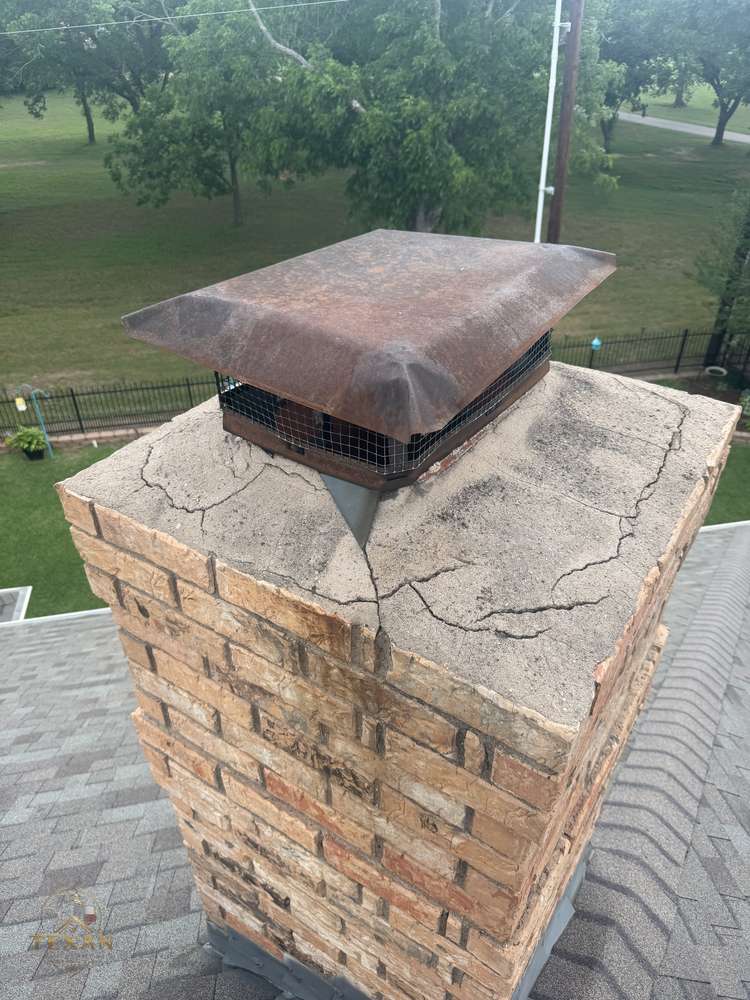
At the very top of your chimney, exposed to every storm that rolls across North Texas, sits a slab of concrete most homeowners never think about — until it fails. The chimney crown is your masonry's first and most important line of defense, and when it cracks, the damage below rarely stays quiet for long. Understanding your crown is the difference between a modest repair and a five-figure rebuild.
The crown is the solid concrete or mortar slab that caps the very top of your chimney, surrounding the flue and covering the exposed brick or stone beneath. Think of it as the roof of your chimney. Its entire purpose is to shed water — angling rain, snowmelt, and sleet away from the flue opening and out over the edges of the masonry, ideally with a projecting overhang and a drip edge that flings water clear of the brick.
When the crown is intact, water simply runs off and disappears. When it cracks, everything changes. That single slab is the one element standing between a Texas thunderstorm and the vulnerable interior of your chimney system. No other component works this hard, and none is more routinely neglected.
Our climate is uniquely cruel to crowns. Dallas–Fort Worth swings from triple-digit summers to hard winter freezes, and that volatility is precisely what turns a harmless hairline into a structural crack.
You do not always need a ladder to spot trouble. Many warning signs are visible from the ground or from inside your home:
Any one of these deserves attention. Together, they signal a crown that is already letting water in.
A crown crack is never just a crown crack. Once water finds its way past that slab, it begins a slow, expensive migration through the entire chimney system. It pools in the flue and rusts the damper until it seizes. It saturates the clay flue tiles, and when winter arrives, freeze-thaw shatters them from the inside — compromising the very liner that keeps combustion gases contained.
From there, moisture travels into the surrounding brick, then into the framing, the ceiling, and the walls of the rooms below. Homeowners who ignore a hairline crack for a season or two often discover the true cost as a stained ceiling, a rotted mantel, or a full liner replacement. The crown was cheap to fix. The cascade never is.
The right fix depends entirely on the crown's condition, which is why an honest assessment matters. Caught early, small hairline cracks can be cleaned, filled, and sealed with a flexible crown coating for a few hundred dollars — a genuine bargain against what water damage costs later. A crown that has crumbled, lost large sections, or was poured incorrectly from the start needs a full tear-off and rebuild, formed properly with an overhang and expansion joint, which runs meaningfully more depending on size and access.
Our approach is never to oversell. If a seal will protect your home, we seal it. If the slab is beyond saving, we rebuild it once, correctly, so you never revisit it. Explore our chimney crown repair service to see how we restore crowns to better-than-builder standard.
Repairing the crown addresses the obvious breach, but the surrounding brick and mortar have already been drinking water for years. A quality breathable waterproofing treatment seals the masonry against future absorption while still allowing trapped vapor to escape — stopping the freeze-thaw cycle at its source. Pairing crown repair with waterproofing is what turns a patch into a lasting solution.
Crown failure is silent until it is expensive, and the surface you most need to see is the one you can least reach. A professional $49 camera inspection puts eyes on the crown, the flue, and the liner, catching hairline cracks and rusted components while the fix is still measured in hundreds, not thousands.
Your crown has been quietly guarding your home through every North Texas storm. Give it the attention it has earned before the next freeze does the deciding for you. Book your $49 camera inspection today, or call us directly at (469) 771-7000. At Texan Flue, we protect your home from the top down — because that is where chimneys meet luxury.
Treat it that way — book a $49 camera inspection and see exactly what's going on inside.
Book a $49 Inspection