Buying a home in Dallas–Fort Worth is one of the largest investments most families will ever make — yet the chimney, arguably the most complex masonry & venting system in the house, is routinely the least understood part of the transaction. A polished mantel and a handsome brick stack can hide tens of thousands of dollars in concealed damage. Before you sign, before you close, and before you inherit someone else's neglect, the flue deserves a proper look. Here is why a real-estate chimney inspection is not a luxury — it is due diligence.
A licensed home inspector is a generalist, and a good one is worth every dollar. But the standard home inspection treats the chimney as a checkbox, not a system. Your inspector will look at the crown from the roof, note the condition of the brick from the ground, confirm there is a cap, and perhaps shine a flashlight up from the firebox. What they cannot do — and are not required to do — is scan the interior of the flue.
That distinction matters enormously. The flue liner is the sealed passage that carries smoke, heat, and combustion gases safely out of your home. It is also where the most expensive, most dangerous, and most invisible failures occur. A chimney can present a flawless exterior while the liner inside is cracked, gapped, or crumbling. The general home inspection report will almost always carry a line reading something like "recommend evaluation by a qualified chimney specialist" — and buyers, eager to close, too often skip it.
The National Fire Protection Association's standard NFPA 211 defines three levels of chimney inspection. A Level 1 is a basic visual check for a system in regular use with no changes. A Level 2 is the standard the industry — and the code — reserves specifically for property transfers, sales, and any change of ownership or appliance. In other words, buying or selling a house is the textbook trigger for a Level 2.
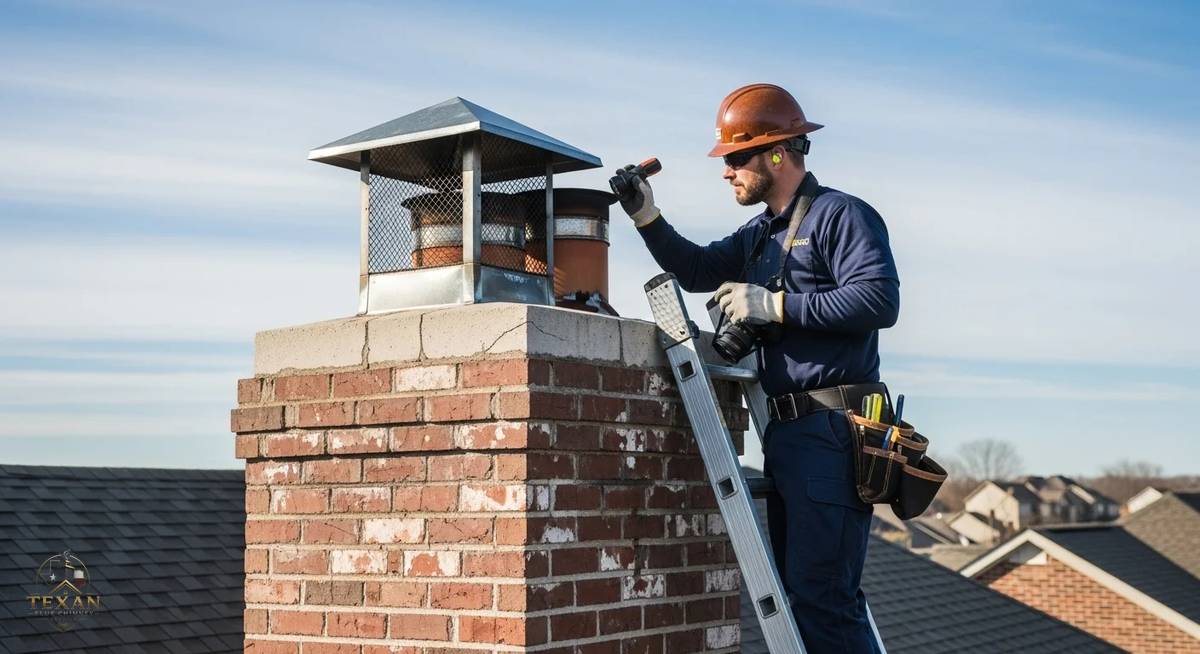
A Level 2 inspection includes everything in a Level 1, plus a video scan of the entire flue interior using a specialized camera, and an examination of accessible portions of the chimney exterior and interior, including attics, crawl spaces, and basements. It requires no demolition, but it does require the right tools and a trained eye. This is precisely the scope of our $49 camera inspection — a real-estate-grade evaluation built for the moment a home changes hands.
When we send a high-resolution camera up the flue, the story the chimney has been hiding finally comes into focus. On a routine DFW transaction, the footage commonly reveals:
None of this is visible from the roof or the hearth. The camera is the only way to know — with certainty — what you are actually buying.
DFW's housing stock is aging into its most vulnerable years. Much of the region was built out through the 1980s and 1990s, and a great many of those homes were fitted with builder-grade prefabricated fireplace and flue systems that were never engineered to last forever. Add to that North Texas's notorious expansive clay soil, which swells and contracts with every wet-then-dry season, and you have a recipe for chimneys that slowly separate, tilt, and crack away from the house. A stack that looked fine at construction can be quietly failing thirty years on — and the buyer inherits it.
The reason a Level 2 pays for itself is arithmetic. Discover a problem before closing and it becomes a negotiation — a credit, a price reduction, or a seller repair. Discover it after closing and it becomes your bill, in full. A flue relining typically runs $2,500–$4,500 depending on the system, and a full masonry rebuild can climb well beyond that. Structural masonry repair on a shifted stack is a significant undertaking in its own right. A $49 inspection that surfaces a $4,000 problem during the option period is the best money you will spend on the entire deal.
Texas gives buyers a powerful, time-limited advantage: the option period. For a small fee, you secure an unrestricted right to terminate — and, more importantly, a window to investigate and renegotiate. This is exactly when your chimney inspection should happen. Schedule it early in the option period, alongside your general home inspection, so the findings can inform any repair requests or price adjustments while you still hold leverage. Wait until the option period closes, and that leverage is gone.
Sellers benefit just as much. A Level 2 report in hand before listing lets you disclose honestly, address problems proactively, and remove a variable that could otherwise derail your sale at the eleventh hour. Nothing kills momentum like a buyer's inspector flagging an unknown chimney defect days before closing. Fix it — or price it in — on your own terms, and you protect both the sale and the sale price.
Every inspection concludes with a detailed written report: still images and video from the flue scan, a clear description of each finding, its severity, and our professional recommendation. Buyers use it to negotiate. Sellers use it to disclose. And real-estate agents value it because it replaces anxiety with documentation — a defensible, transaction-ready record that keeps deals moving and protects everyone at the table.
If you are buying, selling, or representing a home anywhere in DFW, put the chimney on your due-diligence list before the option period runs out. Book your $49 camera inspection or call us at (469) 771-7000, and let us show you exactly what you are buying — because even in the details a buyer never sees, this is where chimneys meet luxury.
Treat it that way — book a $49 camera inspection and see exactly what's going on inside.
Book a $49 Inspection