
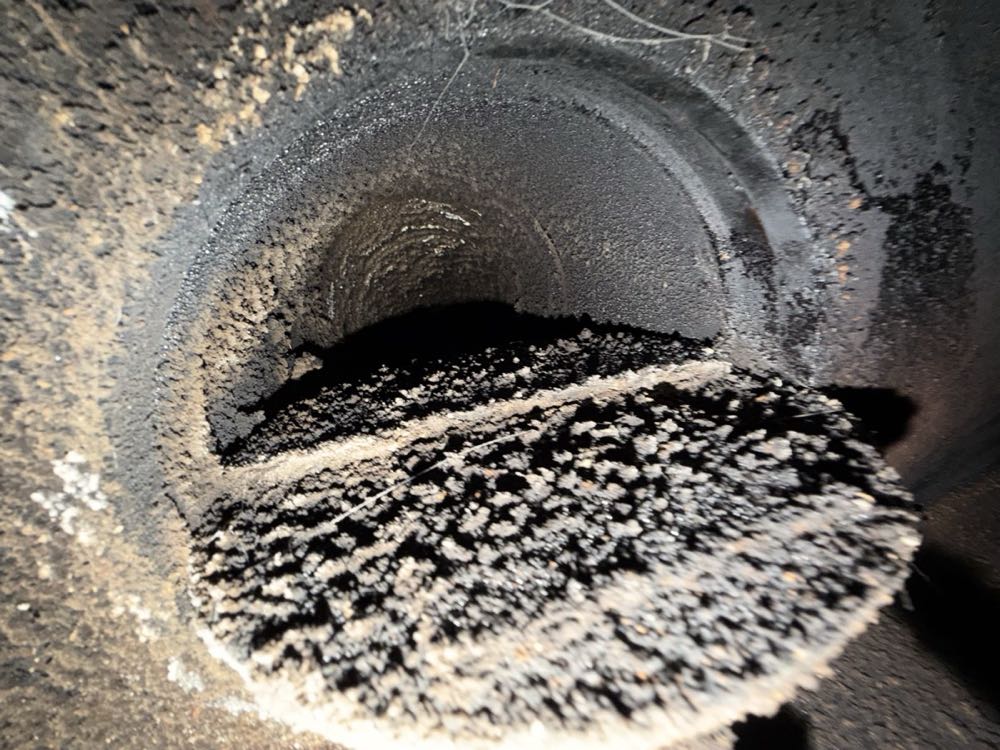
Every wood fire you enjoy leaves a signature behind. It is invisible from the sofa, quiet for years, and entirely manageable when understood — and it is the single most important subject a fireplace owner can master. Creosote is not a reason to retire the hearth. It is a reason to care for it the way one cares for anything of value: with knowledge, routine, and the occasional expert eye.
When wood burns, it releases gases and unburned particles that rise through the flue as smoke. As that smoke meets the cooler surfaces of the chimney, a portion of it condenses — much like breath fogging a cold window — and adheres to the flue walls. That condensate is creosote: a dense, carbon-rich residue that ranges from flaky soot to hardened tar. Two conditions produce it in abundance: cool flue temperatures and incomplete combustion. Slow, smoldering fires, unseasoned wood, and restricted airflow all make smoke linger and condense. And creosote carries one defining property that gives this entire subject its weight — it is flammable. The flue, designed to carry fire's byproducts away, gradually accumulates a coating of concentrated fuel.
Light, dusty, and flaky, first-stage creosote resembles velvet-black powder. It brushes away readily and is exactly what an annual chimney sweep is designed to remove. A household that burns seasoned wood with good draft may never progress beyond this stage.
Second-stage creosote is crunchy, shiny, and tar-flecked — dried droplets and hardened flakes that grip the flue walls. It typically develops where airflow is restricted or fires burn cooler than they should. Removal is still mechanical but demands professional tools and persistence; a hardware-store brush will polish it rather than remove it.
Third-stage creosote, known as glaze, is the form that deserves genuine respect. It develops when fresh creosote condenses over previous layers faster than they can dry, fusing into a thick, hardened coating that resembles poured tar or shiny black glass. Glaze is highly concentrated fuel bonded to the flue. It cannot be brushed off, and because it is dense rather than fluffy, a modest-looking layer represents a substantial amount of combustible material. Glaze is the stage at which a chimney quietly becomes a hazard, and it is the stage that requires professional creosote removal rather than a standard sweeping.
A chimney fire begins when flue temperatures climb high enough to ignite the creosote lining the walls — often during a hot, fast fire, or when a spark or flame reaches an accumulation in the smoke chamber, the flue's most turbulent and deposit-prone region (which is why periodic smoke chamber cleaning matters). Some chimney fires are unmistakable: a low-flying-aircraft roar, dense smoke, flames or sparks visible above the crown. These are the fires people call the fire department about.
But many — by most professional accounts, the majority — announce nothing at all. Slow-burning chimney fires smolder within the flue with too little air to become dramatic, yet with temperatures high enough to crack flue tiles, damage liners, and scorch nearby framing. Homeowners frequently learn of them only when a camera inspection reveals the evidence, sometimes years later. This is the quiet danger: a first, unnoticed fire can compromise the flue's integrity so that a second fire finds pathways to the structure of the home itself.
If you suspect a chimney fire has occurred — even long ago — do not light another fire until the flue has been examined on camera. NFPA 211 specifically calls for a Level 2 inspection after any event likely to have caused damage, and a chimney fire is the textbook example.
Creosote management is largely a matter of habit, and the habits are pleasant ones:
First- and second-stage creosote yield to professional brushes and rotary tools. Glaze does not. Because third-stage creosote is fused to the flue, responsible removal begins with a chemical treatment — professional-grade modifiers applied to the glaze that alter its structure over days, rendering it brittle enough to be mechanically removed without damaging the liner. This is measured, multi-visit work, and it is emphatically not a do-it-yourself project: aggressive scraping of glaze can destroy flue tiles, and the sawdust-style "creosote logs" sold in stores are, at best, a supplement to professional care — never a substitute. If a camera inspection reveals glaze, the honest counsel is simple: the fireplace rests until the flue is clean.
The difference between a chimney that is safe and one that merely looks safe is a camera's length of flue you have never seen. Reserve your $49 camera inspection with Texan Flue or call (469) 980-1178 — and know, rather than hope, that your hearth is ready for its next fire.
Treat it that way — book a $49 camera inspection and see exactly what's going on inside.
Book a $49 Inspection