
A fine home should greet you with the scent of nothing at all — or perhaps of cedar, coffee, or whatever candle you favor. What it should never offer is the sour, smoky breath of a fireplace that has been cold for months. Chimney odor is among the most common calls we receive across Dallas–Fort Worth, and the good news is this: it is almost never mysterious. There are four principal causes, they are all diagnosable, and every one of them has a fix.
Every wood fire deposits creosote — a dark, tar-like residue — along the walls of the flue. In winter, with the fireplace drafting upward, you rarely smell it. In a Texas summer, the equation reverses. Humidity infiltrates the flue and creosote is hygroscopic: it absorbs that moisture and releases its aromatic compounds, producing the classic smell homeowners describe as "wet campfire" or "old barbecue." The warmer and more humid the air, the more generously the odor is released. This is why a fireplace that smelled perfectly civilized in January turns pungent in July. Deodorizers only negotiate with this smell; removing the creosote ends the conversation. A thorough professional chimney sweep addresses the source rather than the symptom.
Here is the counterintuitive part: the smell in your living room is not merely drifting down — it is being pulled down. Newer and recently renovated DFW homes are built tight, with quality windows and sealed envelopes. When your air conditioner, kitchen vent hood, bathroom fans, and clothes dryer all exhaust air outward, that air must be replaced from somewhere. In a tight house, the path of least resistance is often the chimney. The flue becomes a fresh-air intake running in reverse, carrying flue odors straight into the room. This is why the smell often intensifies when the HVAC kicks on. The remedy is to close the pathway: a properly sealing damper — often a top-sealing model that closes the flue at the crown with a gasket — makes an extraordinary difference. If your damper no longer seats firmly, damper repair is frequently the single highest-impact fix for odor.
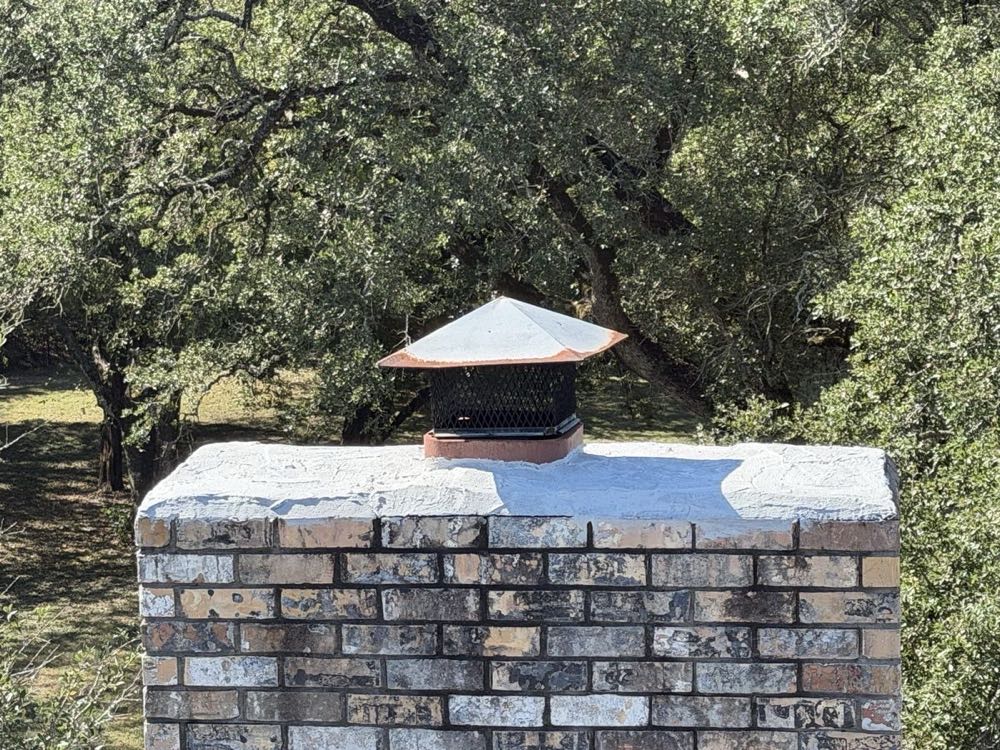
An uncapped flue in North Texas is an open invitation. Birds, squirrels, and raccoons find chimneys irresistible, and their nesting material, droppings, and — regrettably — the occasional trapped animal produce odors that are unmistakable and worsening. Chimney swifts, a federally protected migratory bird, cannot be removed while nesting, which makes prevention far preferable to reaction. Humane animal removal followed by a properly fitted cap closes this chapter permanently. If the smell in your home is organic rather than smoky, this is the first possibility worth ruling out.
A smell of damp basement or old towels — musty rather than smoky — points to water. Rain entering an uncapped flue, a cracked crown, or failing flashing soaks into creosote, masonry, and smoke-chamber parging. Damp creosote smells dramatically stronger than dry, and persistently wet masonry can develop mildew within the chase. Water is also the one odor cause that compounds: what begins as a smell matures into spalling brick, rusted dampers, and damaged liners if left to work. The response should match the cause — a cap if the flue is open to the sky, crown or flashing repair if those have failed, and masonry waterproofing if the brick itself is drinking rainfall.
All four causes share an amplifier: our climate. Heat accelerates the release of volatile compounds from creosote — the same reason asphalt smells stronger in August. Humidity feeds both the creosote reaction and mildew growth. And air conditioning season is precisely when household exhaust fans and cooling systems create the negative pressure that pulls flue air indoors. It is no accident that chimney odor complaints in DFW peak in the summer months, when the fireplace hasn't burned in half a year. The fireplace isn't misbehaving; the physics have simply shifted against it.
Here is how we sequence solutions, from most immediate to most comprehensive:
The order matters. Sweeping a flue that is still swallowing rainwater, or capping a chimney that still holds a decade of creosote, solves half the problem and invites the call-back. A proper diagnosis sequences the work so each step stays solved.
If your fireplace is making itself known in the wrong way, let us find the cause on camera rather than guess. Book your $49 camera inspection or call (469) 980-1178 — Texan Flue will trace the odor to its source and restore your home to smelling like nothing at all.
Treat it that way — book a $49 camera inspection and see exactly what's going on inside.
Book a $49 Inspection