
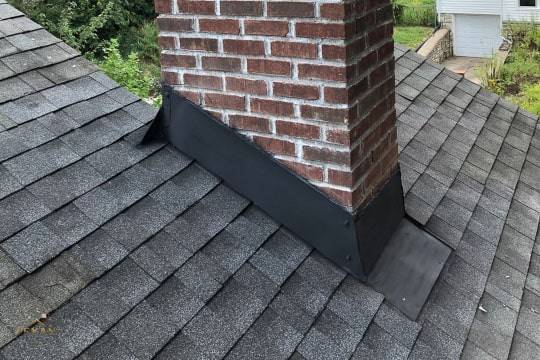
When a water stain blooms on the ceiling near your fireplace, the chimney itself is rarely to blame. In the overwhelming majority of homes we inspect across Dallas–Fort Worth, the true culprit is hiding at the roofline: the flashing. It is the least glamorous part of your chimney and, quietly, the most important. Done right, it is invisible for decades. Done poorly — or left to age — it becomes the single most common source of chimney leaks in North Texas.
At Texan Flue, we treat flashing as the precision work it deserves to be, because a chimney is only as luxurious as it is dry. This guide walks you through how flashing actually works, how to recognize when it is failing, and why a bead of caulk is never a real repair. Every fix begins the same way: with a free, no-obligation estimate and an honest look at your roofline.
Flashing is the system of thin metal barriers that seals the joint where your chimney rises through the roof. Because a masonry chimney and a shingled roof expand, settle, and weather at different rates, that seam can never simply be sealed shut — it has to be layered so that water is guided over the joint rather than trapped inside it.
A proper installation is actually two coordinated layers working together:
The genius is in the overlap: water runs down the brick, hits the counter flashing, is directed onto the step flashing, and is carried harmlessly onto the shingles and off the roof. When both layers are present and intact, this is a nearly permanent defense. Learn more about our approach to chimney flashing.
If you have a leak near your chimney, flashing is the statistical favorite — and for good reason. It sits at the most vulnerable point on the entire roof: a hard vertical wall of masonry interrupting an otherwise smooth plane, right in the path of every drop of rain that sheds off that section of roof.
Several things conspire against it over time. The metal expands and contracts through Texas heat and the occasional hard freeze, working fasteners loose. Builders on volume homes often skip true counter flashing and rely on a surface bead of sealant instead. Storms lift and bend edges. And the mortar joints that anchor good counter flashing slowly erode. Any one of these opens a path, and water is patient — it will find it long before you see the stain on your ceiling.
Flashing problems announce themselves early if you know where to look. Catching them now is the difference between a modest repair and a full framing or drywall project later. Watch for:
If any of these sound familiar, our guide to what a chimney leaking when it rains really means is a useful companion read — and a good reason to have the flashing looked at before the next storm.
It is tempting — and common — to smear a tube of roofing sealant over a leaking flashing joint and call it solved. For a season, it may even seem to work. But caulk is a patch, not a repair, and here is the honest reason why.
Sealant is a soft material bridging a joint that moves constantly. Every hot afternoon and cool night, the metal and masonry shift against each other, and that flexing tears the caulk loose from the inside out. Within a year or two it cracks, shrinks, and peels — often while still looking intact from the ground. Worse, a fresh bead of caulk can hide a failing system, letting water seep behind it undetected until the roof deck or framing is compromised. Proper flashing sheds water through overlapping metal geometry, not adhesion. When the geometry is right, no sealant is doing the heavy lifting at all.
Not every flashing issue requires tearing everything out, and we will never tell you it does. The right answer depends on what we find during inspection, and we walk you through it plainly.
A targeted repair makes sense when the core system is sound: resecuring a lifted section, re-cutting and re-anchoring counter flashing into fresh mortar joints, or replacing a damaged piece while the rest of the assembly remains intact. A full re-flashing is the right investment when the original work was done poorly, when rust has compromised the metal, or when repeated patch jobs have left a compromised patchwork behind. In that case we install a complete, correctly layered step-and-counter flashing system built to outlast the shingles around it. Whichever path fits your roof, you will receive a clear, free, no-obligation estimate before any work begins.
Flashing rarely works alone. On wider chimneys — anything over about 30 inches on the up-roof side — water and debris pile up behind the masonry and overwhelm even perfect flashing. The solution is a cricket (also called a saddle): a small peaked structure built behind the chimney that splits the water flow and diverts it around each side. If your chimney is wide and lacks one, no amount of flashing repair will fully solve the problem.
Flashing is also just one layer of a chimney's total defense against water. The masonry itself, the crown at the top, and the mortar joints all absorb and shed moisture, which is why we look at the whole system rather than a single seam. Pairing sound flashing with breathable waterproofing gives your chimney a complete, coordinated barrier — the standard of dryness and longevity a luxury home deserves.
It takes an inspection to be certain, but flashing is the most common cause by far, especially when the stain appears near the roofline and worsens after rain. A crown crack, failing mortar, or missing cap can also let water in, which is why we evaluate the entire chimney rather than assuming. Your inspection and estimate are always free and no-obligation.
You can, but it is a short-term patch, not a repair. Because the metal and masonry move constantly with temperature swings, caulk cracks and peels within a season or two — and a fresh bead can mask a failing system while water quietly damages the roof deck behind it. Proper flashing sheds water through overlapping metal, not adhesive.
It depends on whether you need a targeted repair or a full re-flashing, the size and pitch of your roof, and the condition of the surrounding masonry. Rather than guess, we give you an exact, itemized price after inspecting your specific chimney. Every quote comes as a free, no-obligation estimate with no pressure to proceed.
A cricket, or saddle, is a small peaked structure built on the up-roof side of the chimney to divert water and debris around it. Wider chimneys — generally over 30 inches — benefit greatly from one, since water otherwise pools behind the masonry and overwhelms the flashing. We will tell you honestly whether yours would benefit.
A correctly installed step-and-counter flashing system, anchored into the mortar and layered properly, can last for decades — often outliving the shingles around it. Pairing it with breathable waterproofing extends the protection of the whole chimney. The key is doing it right the first time, which is exactly the standard we build to.
Protect your home from the next North Texas storm with a proper flashing repair — call Texan Flue today for your free, no-obligation estimate at (469) 771-7000.
Treat it that way — book a free estimate and see exactly what's going on inside.
Get a Free Estimate